Showing posts with label Romantic. Show all posts

Tuesday, August 11, 2020

Schreker - Nachtstück from Der ferne Klang

I've been working through a large collection of classical music CDs I was given a couple of summers ago, but only started deeply exploring lately.

Last week, I first listened to selected works of Franz Schreker, an Austrian composer best known for his operatic works. Der ferne Klang (Ger: 'The Distant Sound) is an opera he began drafting in 1901 and completed the libretto for in 1903. He reportedly abandoned the project for several years before finishing the orchestral score six years later in 1910 due to criticism from his composition instructor [1].

In general, I don't really like listening to opera — though I know this closes off a truckload of writing from the pre-Classical era and so many Baroque, Classical, and Romantic works(!) — but this orchestral-only setting of the Nachtstück (Ger: 'Night Song') from Der ferne Klang is breathtaking.

Since the score for this piece is so much longer than the other pieces I have analyzed, and leaves out the vocal parts from the original opera, I'll leave the scorereading from the score to you. The score for the Nachtstück starts at Ein wenig langsamer on page 33 of the Act III full score (1912 Universal Edition [Plate U.E. 3097], Vienna) and page 243 of the complete (condensed) vocal score (2004 Universal Edition [Plate U.E. 32926], Vienna) from IMSLP.org.

In both versions of the score, the music stops following the recorded piece a few times. The parts of the recording that are captured in the score are as follows (with score rehearsal numbers in boldface):


Beginning (five bars before 26) up to 44 (0:00-10:00)

Rejoins at 44 and leaves just before 48 (12:57-15:15)

Hope you enjoy listening to this piece and leave your thoughts below!

[1] Wikipedia - Der ferne Klang

Tuesday, August 4, 2020

Brahms - Serenade No.1, Op.11 - V. Scherzo II

Once again discussing my favorite composer, Johannes Brahms, I'm sharing this quick post about Brahms's Serenade No.1, Op.11, V. Scherzo II.

Brahms actually hesitated to write a symphony after becoming an overnight sensation due to a glowing testimonial by fellow composer and mentor Robert Schumann. Brahms felt that any symphony he wrote would be overshadowed by the legacy of Beethoven. However, in writing such works as his two Serenades (Opp.11 and 16), a piano concerto (Op.15), and others, he was able to get practice writing for larger ensembles without having to live up to his extraordinarily high standard for a symphony.

Brahms worked on his first symphony for a whopping fourteen years from 1862 to 1876. When it was finally performed in November 1876, it was a spectacular success and Brahms's first symphony was dubbed "Beethoven's Tenth" and he then reached the public eye as a true master of conservative Romantic composition.

The Serenades provide an interesting look into Brahms's developing voice as an orchestral composer. His harmonic language is far less diverse in the Op.11 than even in the chamber music and grandiose piano concerto that followed it. However, his compositional skill is exemplified in his gift for melody and his ability to handle any motif freely; these skills are apparent even in these early works.

I hope you enjoy the second Scherzo, as well as the rest of the Serenade! Share this post if you enjoyed it and leave your thoughts below!

Monday, July 27, 2020

Mendelssohn - Lieder ohne Worte, Op.30, No.6 - Venetianisches Gondellied

*This post is part of a series on a cycle of short piano works by Felix Mendelssohn. Feel free to read the other posts, linked below!*

Lieder ohne Worte (Book 2), Op.30
1. Andante espressivo (E♭) (post)
2. Allegro di molto (b♭) (post)
3. Adagio non troppo (E) (post)
4. Agitato e con fuoco (b) (post)

To finish off his second cycle of Lieder ohne Worte, Mendelssohn wrote a swaying barcarolle (or 'barcarole') in f# minor entitled Venetianisches Gondellied or "Venetian Gondola Song." The swaying feeling arises from the juxtaposition of offbeat rhythmic accents and the musical structure of a bar of 6/8, the time signature of the piece.


Typically, a measure of 6/8 has accents on beats 1 and 4. However, Mendelssohn puts two pitches together on beats 3 and 5, creating the feeling of 3/4While the rhythmic accents fall on beats 1, 3, and 5, the contour of the left hand line produces natural accents on the usual beats 1 and 4 in 6/8.


Accompaniment figure with implied accents (m. 1)

The result is a figure which blurs the two time signatures, which opens the piece at a comfortable Allegretto tranquillo.


A singing melody (aptly marked cantabile, It. "as if singing") rings over the accompaniment, beginning in m. 7 with pickups (m. [6]). The melody occurs in two eight-bar phrases, the second of which reappears in the repeated section. Each phrase is given its own system of music below:


The second eight-bar phrase actually stretches over the repeat sign and into the middle section of the piece, which contains an eight-bar phrase, two bars of accompaniment, and a four-bar phrase in b minor.


The eight-bar phrase beginning at the pickups to m. 23 through m. 30 gets me every time, starting melancholy and growing brighter. The dynamic push towards the ff at m. 29 (and, critically, the marking of più f in m. 26-27 [in the original score, it is spread over both bars]) makes the emotion even more potent.

After Mendelssohn modulates from b minor back to f# minor, he writes the same melody as the second phrase of the first section (highlighted). However, it does not feel like an eight-bar phrase.

Rather, it feels like two bars of accompaniment (mm. 37-38) and a four-bar phrase, due to the bass note being C# rather than F#, leading to a perfect authentic cadence (i64—V—i) that creates the closure felt in m. 39 (rather than where the returning melody starts at m. 37). The top of the repeat sounds again like it begins just with two bars of accompaniment before the eight-bar phrase picks up at m. 23.


The end of the repeat bleeds right into the heart-rending coda. The change in the rhythm of the accompaniment figure, and the fact that it plays an essential role in the melody (which is really just a series of chords) changes the mood of the piece entirely.

The downward linear motion initiated by the melody, followed by the bass, and the dynamic arc reaching its height at the lowest point in the bass line (marked with crescendos both times, adding sfz the second time) makes the coda the emotional epicenter of the piece. Considering it is the last of the cycle, it is a pretty powerful musical device for a piece that starts so plainly (just by visually comparing this analysis to the other pieces, it's harmonically much more straightforward).

After the twice-repeated descent, a simple ending with a tonic f# minor arpeggio (m. 51) over the opening accompaniment figure brings the piece full circle as the accompaniment slows to a stop and the melody evaporates into silence.

Thanks for following this series of posts on Mendelssohn's Lieder ohne Worte, Op.30! Share the posts and leave your thoughts in the comments below.

All score excerpts taken from the Breitkopf & Härtel edition (Leipzig) via IMSLP.org.

Sunday, July 26, 2020

Mendelssohn - Lieder ohne Worte, Op.30, No.5 - Andante grazioso

*This post is part of a series on a cycle of short piano works by Felix Mendelssohn. Feel free to read the other posts, linked below!*

Lieder ohne Worte (Book 2), Op.30
1. Andante espressivo (E♭) (post)
2. Allegro di molto (b♭) (post)
3. Adagio non troppo (E) (post)
4. Agitato e con fuoco (b) (post)
6. Venetianisches Gondellied ("Venetian Gondola Song"), Allegretto tranquillo (f#) (post)

Before beginning this series of posts, I did not originally find this Lied as appealing as the others. But, in listening to it repeatedly to understand the structure and harmony of the piece and write this post, I've grown to really enjoy it! Let's jump right in.


The piece is in song form, roughly A—A—B—A, with a coda. The A section is marked off with repeats, and contains two clearly identifiable phrases which appear in the A section reprise. Marked at Andante grazioso ("gracefully, at a walking pace"), one might initially expect to hear quite relaxing music. However, a constant "filigree" of thirty-second notes underlines the entire piece. These 'runs' often indicate where the harmonic direction lies.


Developmental material appears in the B section, which sees a transition from one tonic to another (as indicated by the harmonic analysis). Two short phrases, each appearing in repetition, occur in nearby keys. The first short phrase appears in e minor (centering on V7 = B7) and then f# minor (centering on V7 = C#7), while the second short phrase appears in b minor and then in f# minor (note the parallelisms in the harmonic analysis). These two phrases lead to a repeating figure (mm. [20]-23), ultimately reducing to the left-hand run.

I really enjoy the B section of this piece. The B section modulates several times, pushing the functional tonic further into "sharps" territory on the circle of fifths (b minor → f# minor) with plenty of V's, adding even more sharps (V42/V/III in f#, m. 19). The B section's much faster harmonic rhythm also brightens it. The second short phrase's interweaving counterpoint is very pleasing even as it rapidly shifts tonal centers (all nearby on the circle of fifths, but restless nonetheless) and the repeating figure (VI—iv64i64, m. [20]-23) is really bold.


After the f# minor chord ending the B section fades, the A section reprise begins. The reprise modifies the melodies of the original A section, highlighted with the same color scheme as the original A section above. Mendelssohn's extension of the A section with a modified second segment of the melody allows for an alternate conclusion to the reprise (mm. 36-37, which I quite like for its warmth), leading to the coda, marked dolce (It. "sweet", "tender").


Unlike the B section, the coda takes harmony closer to the "flats" on the circle of fifths (D major → G major). The use of the root D as a dominant D7 (I—V7/IV) to resolve to G major with repeated plagal cadences (IV—I) establishes a warmer feeling to the coda than before, as C# is sometimes altered to C♮. In fact, only in the coda do we see any flats anywhere — Mendelssohn uses a ♭9 (A7♭9) to darken the harmony. I also enjoy the last repeated phrase (mm. [40]-44; the only harmonic deviation between the instances is in m. 43). The piece floats upwards and dissipates with a sparkly D major arpeggio.

Hope you enjoyed listening to and learning about this Lied! Check back for the last post on this cycle of Lieder ohne Worte soon. Share this post and comment below!

All score excerpts taken from the Breitkopf & Härtel edition (Leipzig) via IMSLP.org.

Saturday, July 25, 2020

Mendelssohn - Lieder ohne Worte, Op.30, No.4 - Agitato e con fuoco

*This post is part of a series on a cycle of short piano works by Felix Mendelssohn. Feel free to read the other posts, linked below!*

Lieder ohne Worte (Book 2), Op.30
1. Andante espressivo (E♭) (post)
2. Allegro di molto (b♭) (post)
3. Adagio non troppo (E) (post)
5. Andante grazioso (D)
6. Venetianisches Gondellied ("Venetian Gondola Song"), Allegretto tranquillo (f#)

This was the first piece of the cycle that I heard several years back (on YouTube), and I later found the others in my recommendations. This fast-paced scherzo is closer to sonata form than the other Lieder. The complete sonata form is comprised of an introduction (usually tonic), an exposition (usually dominant), a development, a recapitulation (usually tonic), and a coda.


The introduction is less than two bars of straight sixteenth notes in 3/8, and the exposition begins at Agitato e con fuoco ("agitated and with fire") immediately setting the tone. While the melody plays, staccato sixteenth notes provide rhythmic energy, interspersed with bass notes on the downbeats. 

Mendelssohn modulates pretty quickly, first into f# minor for a short phrase (mm. 12-23), and then into D major for the recapitulated phrase (mm. 24-33; we'll see it again later). I especially like Mendelssohn's clever use of the G-B third (mm. 34-35) to modulate from D major back to b minor smoothly in the first ending.

The start of each phrase is marked with a red arrow, while the middle of each phrase is marked with a maroon arrow. The first phrase is eight bars (mm. 3-10), where the first half (mm. 3-6) is imitated in the second eight-bar phrase (mm. 11-14 [4 bars] of mm. 11-18  [8 bars]).


The development, starting at the second ending (m. 36), is marked off by a phrase in parallel motion. The eight-bar phrase has two "mini-phrases." The first (marked by a red arrow, m. 36) seems to lean into a minor, and the second (marked by a maroon arrow, m. 40) leans into b minor. Note the chord progression in each indicates the exact same harmonic relationships.

The next eight bars have a similar structure, the same phrase in two keys (four bars each) in parallel motion and followed by a two-bar link. The first mini-phrase starts in e minor (V—V7—i6 in e) and the second on C major (VI—V7/VI—VI6 in e or I—V7—I6 in C). There are several ways to interpret this, but the parallelism is apparent from the visual similarity and the identical rhythms.


A series of descending arpeggios takes us from e minor to b minor via the Neapolitan sixth (N6 = C in b minor). A German augmented sixth (Ger+6 = "VI♭7" = G7 [G/B/D/F] written as G with an E# [G/B/D/E#] in b minor) precedes the dominant F#, which alternates with ii⌀42 to raise the tension as the notes travel higher and higher. The tension swirls with undulating scales on F#7♭9 (V7♭9 = F#/A#/C#/E/G) with three key dissonances: between the root and ♭9 (F#/G), the first tritone (A#/E), and the second tritone (C#/G).


The extended F#7♭9 marks the end of the development, transitioning right into the recapitulation, which starts with two instances of the yellow melody back-to-back. Mendelssohn introduces some new material into the recapitulation as well (imperfect sonata form). Three two-bar segments of alternating chords (dominant-tonic function) circling around b minor bridge the first part of the recapitulation to the second. The green melody reappears, ending the recapitulation with a seamless blend to the coda.


The coda begins with another eight-bar phrase, made up of two copies of a four-bar "mini-phrase." The next six bars (in two-bar "mini-phrases") lead to the climax of the piece, admittedly almost at the end of the piece. The dynamic height and tension of the d#°7 and F#7♭9 following it, and the relentless hammering of octave F#s underlining it, build straight to the last phrase of the piece.


A smattering of quickly alternating chords, usually dominant-tonic function pairs (implied functions open to interpretation are marked in parentheses), quickly flutters to the last strain of the opening motif. Hanging onto a tenuto third in the melody, the remaining staccato chords decrescendo as the melody fades out, closing out the final "fast" Lied of this cycle.

Hope you enjoyed reading and listening! Check back for more on the other Lieder in future posts, leave your comments below, and share this post!


All score excerpts taken from the Breitkopf & Härtel edition (Leipzig) via IMSLP.org.

Friday, July 24, 2020

Mendelssohn - Lieder ohne Worte, Op.30, No.3 - Adagio non troppo

*This post is part of a series on a cycle of short piano works by Felix Mendelssohn. Feel free to read the other posts, linked below!*

Lieder ohne Worte (Book 2), Op.30
1. Andante espressivo (E♭) (post)
2. Allegro di molto (b♭) (post)
4. Agitato e con fuoco (b) (post)
5. Andante grazioso (D) (post)
6. Venetianisches Gondellied ("Venetian Gondola Song"), Allegretto tranquillo (f#) (post)

This delicate intermezzo in E major provides major contrast to the swiftly galloping Lied in b♭ minor which precedes it. Though there are only two main themes, Mendelssohn uses large dynamic ranges and suspensions to motivate the melodies. A large responsibility is placed on the performer to sculpt the piece carefully, as there isn't a large volume of music to work with — and, unlike most of the other Lieder, much of the material in this piece is only heard once. Let's have a look.


The pieces opens with three presumably quiet E major arpeggios, "presumably" because Mendelssohn actually provides no dynamic marking at the opening.


What does recur is a four-bar melody (or three and two-halves bars, as the melody opens on a half-bar pickup) in two parts. The first part is sometimes replaced or altered (I love the sparkle of c# minor with the third in octaves), while the second fragment always appears as first written. Note the difference in dynamics between the two instances of the second fragment.


The middle of the Lied modulates to B major temporarily, resting on a pedal F# and reaching the height of its dynamic intensity with two sfz ("sforzando," suddenly with force) markings. Note the linear motion in the bass at the start of this segment, growing louder until the climax.


I really like Mendelssohn's use of sequential motion with chords (rather than just one voice) to produce successive suspensions (especially mm. 13-14), something he does frequently in this book of Lieder ohne Worte (see post on No.2).

The closure of the climactic phrase ties leads to a repeated bar of heartwarming melody before modulating back to E major to repeat the corresponding four-bar melodies. Note the musical effect of specifically marking tranquillo (It. "tranquil," "peaceful") for the second instance second melodic fragment (m. 23), compared to just p the first time around in m. 9.


Mendelssohn writes a repeated call in e minor and a repeat of the second fragment of the four-bar melody before wrapping up the Lied just as it started.


Hope you enjoyed this short and sweet Lied, and check in soon to explore the other Lieder! Share this post and leave your comments below.

All score excerpts taken from the Breitkopf & Härtel edition (Leipzig) via IMSLP.org.

Thursday, July 23, 2020

Mendelssohn - Lieder ohne Worte, Op.30, No.2 - Allegro di molto

*This post is part of a series on a cycle of short piano works by Felix Mendelssohn. Feel free to read the other posts, linked below!*

Lieder ohne Worte (Book 2), Op.30
1. Andante espressivo (E♭) (post)
3. Adagio non troppo (E) (post)
4. Agitato e con fuoco (b) (post)
5. Andante grazioso (D) (post)
6. Venetianisches Gondellied ("Venetian Gondola Song"), Allegretto tranquillo (f#) (post)

Road map: Like No.1 of this "book," this piece is a condensed ternary form with a coda. The first theme ("A") constitutes the first repeat, and the second theme ("B") starts at the second ending. A modified theme A (modulated phrase ending) bridges the two appearances of theme B. The coda is appended to the end of theme B's second appearance and swiftly concludes this short piece.


The opening figure is interesting for a couple of reasons. The first melody that the ear latches on to isn't a conventional melody -- it's really just a rhythmic figure that happens to be melodic. However, at m. 3, a brief interruption from a middle voice of the piano keys the listener into where the real melody appears in m. 5. The bouncing bass line in m. 5 also changes the intensity of the music — keep looking out for the bass motion as you listen (marked in important spots in the score).

The second strain of the melody begins the same way in m. 9, but a modulation to the relative major (D♭) changes the function of the b♭ in m. 10. The staccato triplets morph into swinging triplets, relaxing the tone. A typical progression around the circle of fifths [vi—ii9—(I64)—V—I], plagal cadence [IV—I], and an authentic cadence with suspension [V9—I] lead right to the repeat as the staccato triplet rhythm picks back up.


The harmonic analysis from mm. 14-17 oversimplifies the action in the music — the lighter red lines indicate where the chord change could either be perceived as two different chords, or just a chord in suspension that is resolved on the upbeat of the triplet. The analysis assumes the first case, but if we apply the second, those four bars can be interpreted with two suspended notes (in thirds) resolving on the third sixteenth note (𝅘𝅥𝅮𝅘𝅥𝅯┋𝅘𝅥𝅮𝅘𝅥𝅯) in mm. 14-16. Note the doubling in the left hand.

Suspensions and resolutions in mm. 14-17

The B section begins at the second bar of the second ending (m. 20) with a swinging rhythm (𝅘𝅥𝅮𝅘𝅥𝅯┋𝅘𝅥𝅮𝅘𝅥𝅯) indicated by the articulations, even though the notes change on beats 2 and 5 (𝅘𝅥𝅯𝅘𝅥𝅯𝅘𝅥𝅯𝅘𝅥𝅯𝅘𝅥𝅯𝅘𝅥𝅯). A temporary tonic (e♭) holds from mm. 19-22, and the motif from those bars repeats in the relative major G♭. The melody switches between the same few chords (V6—V—ii⌀42—vii°7/V—V) several times, hovering around the dominant of F, before we reach the modified theme A. The successive suspensions occur always on the swinging (𝅘𝅥𝅮𝅘𝅥𝅯┋𝅘𝅥𝅮𝅘𝅥𝅯) rhythm noted earlier.


The first half of the modified theme A is identical to that of the opening of the piece; while the rhythms and voicings of the second half are nearly the same (slightly sparser voicing without thirds on all the suspensions), the chords are cast in the tonic of b♭ minor rather than the relative major D♭. The left hand also doubles the right in the series of suspensions with the swinging (𝅘𝅥𝅮𝅘𝅥𝅯┋𝅘𝅥𝅮𝅘𝅥𝅯) rhythm.  The original theme A is shown in relief for comparison — the harmony is not linearly translated from one key to another, but the general flow is the same.

original theme A (mm. 9-18) in relief

Theme B returns identically, and theme A seems to return identically ... until Mendelssohn foreshadows a modulation to B♭ major using the ♭6 of b♭ minor (G♭ = F#) as the augmented #2 for E♭ major (IV in B♭). The chromatic motion is unlike other material found elsewhere in the piece (the use of accidentals in the analysis was rarely needed before this point).


This sets the piece off on the coda, which has mostly standard cadences with a couple of unusual ones. Mendelssohn makes use of C7, the secondary dominant of F, but rather than a V7/V—V7—I cadence, he quickly brings C7 (V7/V) back to cm7 (ii) via B♭ (I64). He ultimately "resolves" with ii7—V42—I6 (m. 86-87), but the choice use of inversions delays the feeling of resolution (none of these are perfect cadences with chords in root position).

I personally like the tension of the augmented #5 in m. 88 — the combination of the closed voicing in the tenor register and the dissonance between the #5 and ♭7 is exciting at such a fast pace.

Finally, a resolution in m. 93 brings us a perfect authentic cadence, while the bass line bounds away alternating between V and I and the right hand gallops along with triplets. A series of brightly scored suspensions, with octaves in the upper voice, leads to a scalar cascade extending the dominant. Mendelssohn writes a series of resonant B♭ chords to close the second piece. The Picardy ending (major ending to a minor piece) releases the tension built up in the earlier themes.

Thanks for reading, and check back for new posts on the other Lieder soon! Leave your thoughts in the comments below and share this post!

All score excerpts taken from the Breitkopf & Härtel edition (Leipzig) via IMSLP.org.

Wednesday, July 22, 2020

Mendelssohn - Lieder ohne Worte, Op.30, No.1 - Andante espressivo


*This post is part of a series on a cycle of short piano works by Felix Mendelssohn. Feel free to read the other posts, linked below!*

Both Felix and Fanny Mendelssohn were talented Romantic era composers, and both accomplished pianists in their own rights, but social conventions of the time and history favored the publication and dissemination of works by the brother Mendelssohn, while the sister Mendelssohn was primarily a concert pianist. In fact, a few of Fanny Mendelssohn's compositions were published under her brother's name.

However, I want to share one of the pieces Felix Mendelssohn (hence forth "Mendelssohn" unless otherwise indicated) wrote as part of several cycles of short piano pieces called Lieder ohne Worte or "Songs Without Words." Generally, Lieder or "songs" are pieces for solo voice (often soprano) and piano or other accompaniment; these works for solo piano have no lyrics.

In all, Mendelssohn published eight "books" (opuses or opera) of Lieder ohne Worte, each containing six pieces. Today we'll begin looking at the Op.30 (Book 2).

Lieder ohne Worte (Book 2), Op.30
2. Allegro di molto (b♭) (post)
3. Adagio non troppo (E) (post)
4. Agitato e con fuoco (b) (post)
5. Andante grazioso (D) (post)
6. Venetianisches Gondellied ("Venetian Gondola Song"), Allegretto tranquillo (f#) (post)

Let's start at the beginning!

Marked "expressively, at a walking pace" (moderately slow), this calm opening piece is in ternary form, with two large repeated segments and a coda.

The piece spends only one bar introducing the ostinato triplet rhythm (green L.H., pink R.H.) that persists through all but three bars of the piece. The melody, warm and cozy (cerulean), superimposes the duple feel of a dotted quarter note-eighth note rhythm (𝅘𝅥. 𝅘𝅥𝅮) over triplets. The polyrhythms can be difficult to perform, but is beautiful when played smoothly.


The melody appears in two strains in the A section, first following a typical ii—V—I progression. Mendelssohn uses ii6 (f) instead of a root position ii, which allows the bass to move from A♭ to B♭ rather than from F. This smooths out the bass line (major second vs. perfect fourth jump) and allows for a more seamless dynamic arc — the sfz or "sforzando" in m. 5 directs the performer to pay with strong emphasis. The A♭ bass going from a single pitch to doubled (octave, m. 4) prepares the sfz, and the lack of another bass articulation for the rest of m. 5 allows the sound to relax in a contiguous fashion, drawing the ear towards the polyrhythm in the right hand.

The second strain of the melody is the same as the first for two bars, but the pedal note C sticks around, temporarily keeping the tonic there. Mendelssohn brings in some tension by digging into the minor vi (c minor), using its dominant G7 to solidify it. After two passes on G7—c, Mendelssohn uses a perfect fourth motion in the bass voice to return to E♭ major via a typical progression: vi—I64/V—V7/V—V—I (next phrase).

c minor (iv) has predominant function, and though B♭ (I64/V) is the dominant of E♭, debate still rages over whether to actually call it a I chord. I like to emphasize that it is a cadential I64; that is, its function is not as a I chord but rather as a precursor to the dominant as part of a perfect cadence (I64—V—I). That perfect cadence takes place within the dominant of B♭, so Mendelssohn just returns the A♮ (yellow) to A♭ to establish B♭ as the dominant again (B♭7).


In the first ending of the repeat, Mendelssohn continues in scalar motion with sixth intervals between L.H. and R.H., but again brings in an A♮ form a secondary dominant (F7 is the dominant of B♭7) in a V/V—V—I progression as V42/V—V65—I, ultimately returning to E♭. The consonance of the middle voices playing a relatively dissonant chord in an unusual voicing (the notes of the V65 (B♭7) are all densely packed in the tenor register) blends perfectly back into the repeated bar (m. 2).

I love how many times Mendelssohn falters from resolving all the way to E♭ even in this short opening — while the music is stylistically marked with Andante espressivo, tranquillo in m. 11, and a general feeling of warmth and homeliness, the harmony keeps wandering about. This wandering harmony is a good setup for the B section, which is led into through the second ending of the first repeat.


The B section, contains some new material in modulation, a return of the opening melody, and the new material in the home key. The modulation takes place over relatively sparse music, with several alternating chords occurring smoothly with thirds added in the R.H. part.

By turning G into G♭ in the second ending, Mendelssohn sets up a seamless transition to e♭ minor. At p, with octaves in this much darker key, Mendelssohn starts the R.H. ostinato triplet pattern with e♭ minor and establishes a new melody for the B section with a repeating rhythm for four bars in two two-bar segments. In the second segment, Mendelssohn changes the R.H. triplets to G♭ major, which makes that second occurrence both warmer and more grounded.

However, that grounding in G♭ does not last long — Mendelssohn does write a G♭ major chord, but uses it in second inversion as III64 (unstable), alternating with D♭7 as V7/III (the dominant that III64 wants to shift its tension to). The use of pedal through mm. 18-19 (start Pedal Mark 1.svg and end Music-pedalup.svg) and the return of the triplet figure (start is highlighted green) also increase the tension. Rather than resolving to III in root position, he throws the listener for a twist and chromatically shifts to D♮ for d°7 (vii°7, preceded by a suspension) to resolve to e♭ minor.

He drops the tension as he leaves the unstable G♭ major by going from octaves in the bass (starts in green at m. 14) and switching to single notes (transitions from mm. 19-20). The tension again purely by dynamics this time — Mendelssohn has gotten rid of octaves in the bass, and the triplet pattern from the opening of the piece was established two bars prior. Repeated sfz markings emphasize the a♭ minor chords as the space between them closes ... and then widens with the diminuendo and drop to a single treble voice. That uses an f⌀7 chord, where two simultaneous resolutions take place (C♭—B♭ and A♭—G♮) to return to E♭ major for the second part of this repeat (highlighted with original color scheme).


In the second half of the B section, the A section melody returns for four bars in a slightly modified form. The maroon highlight in m. 26 shows a suspension of G over f minor just after going from first inversion to root position (ii6 to ii), ringing brightly over the bass, now in octaves. The music broadens with bass octaves, the return of pedaling, and the sfz suspension emphases in mm. 28-29. I personally love the resolution of 7 to c in m. 29 and the two back-to-back suspensions in m. 30, as they make for a truly satisfying end to the B section. The performer is instructed twice in just four bars to play espressivo — this is reinforced through several performance indications and musical formulation.
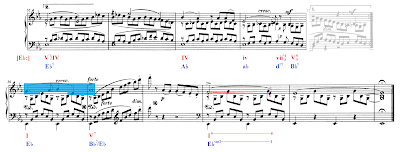

The repeat to e♭ minor restarts the B section, and the second ending brings a new twist. Mendelssohn plays with dominants in the first ending of the A section, but here he uses dominants going the opposite direction around the circle of fifths. Rather than the dominant of E♭ (B♭7), he turns E♭ into the dominant: E♭7. He "resolves" this to a second inversion A♭ (IV64), lowers this chord's third (iv64), lowers this chord's fifth (7), and returns to E♭ with the same one-beat figure on V65 (B♭7) as in the first ending of the A section (see m. 12; shown in relief).

Mendelssohn brings back the opening motif of the melody one last time before a rising B♭7 arpeggio fizzles out in wisps, leaving only a brief closing with an expanded resolution to finish off the first Lied.

We'll have a look at the other Lieder in future posts! Share this post and leave your thoughts in the comments below!

All score excerpts taken from the Breitkopf & Härtel edition (Leipzig) via IMSLP.org.